Sachar Dental NYC
Schedule online now - appointments available.

For SAME day / emergency appointments
Call (212) 752-1163
All the below content has been written by NYC Dentist, Dr. Sandip Sachar.
What Happens If You Wait Too Long to Replace a Missing Tooth?
Losing a tooth is more common than many people realize. Whether caused by decay, gum disease, or sudden trauma, a missing tooth is often viewed as a problem that can be addressed later. When the gap is not immediately visible or painful, many patients delay treatment, assuming that one missing tooth will not significantly affect their oral health.
Dental research and decades of clinical experience suggest otherwise. Tooth loss initiates a cascade of biological and structural changes in the mouth that progress quietly over time. In a city like New York city--where busy schedules and deferred care are common-- these changes often go unnoticed until they begin to affect comfort, appearance, or future treatment options.
Modern dentistry offers reliable, long-lasting solutions for replacing missing teeth. However, delaying treatment can compromise oral function, alter facial structure, and increase the complexity of future care. Understanding what happens beneath the surface explains why timely tooth replacement is considered preventive care rather than a cosmetic decision.
Jawbone Deterioration From Missing Teeth
The jawbone is a living tissue that depends on regular stimulation to maintain its strength and density. Natural tooth roots transmit chewing forces into the jawbone, signaling the body to preserve bone volume. When a tooth is lost, that stimulation stops.
As a result, the body begins to resorb the unused bone. Bone loss can begin within months after tooth loss and continues gradually when the space is left untreated. Over time, this reduction in bone volume weakens the foundation of the mouth and limits the jaw’s ability to support future restorations.
Prematurely Aged Appearance and Loss of Lip and Cheek Support
Progressive bone loss and missing teeth may reduce support for the lips and cheeks over time, contributing to a prematurely aged appearance. Teeth and underlying bone provide essential support to the lips and cheeks. With missing teeth and progressive bone loss, this support diminishes, causing the soft tissues to sag or hollow inward. These structural changes can contribute to a sunken or collapsed-looking facial profile, deeper lines around the mouth, thinner lips, and hollowed cheeks-- features commonly associated with an aged appearance.
These changes are not merely cosmetic; they reflect a loss of structural integrity that can directly affect long-term oral health and treatment outcomes.
Bone resorption begins early and progresses over time, making prompt replacement critical.
Tooth Movement and Bite Changes
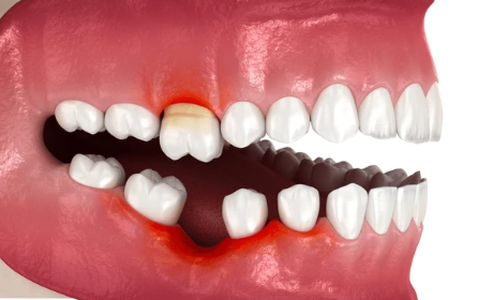
Teeth function as a balanced system, relying on contact with neighboring and opposing teeth to remain properly aligned. When a tooth is missing, that balance is disrupted.
- Adjacent teeth may drift into the empty space
- Opposing teeth may extend beyond their normal position and into the empty space
This type of disruption of bite alignment, may increase the load and stress on remaining teeth and jaw joints
Also, as alignment shifts, teeth often become more difficult to clean. This increases the risk of cavities and gum disease in teeth that were previously healthy.
Even a single missing tooth can trigger gradual but significant changes in bite stability and overall dental health.
Consequences of Delayed Tooth Replacement
Chewing
Each tooth plays a specific role in breaking down food. Missing teeth reduces chewing efficiency, often causing patients to favor one side of the mouth. Over time, this habit can strain muscles and jaw joints on that side and limit the ability to eat certain foods comfortably or trigger jaw pain (TMD).
Inadequate chewing may also affect digestion, as larger food particles are more difficult for the body to process.
Speech
Teeth guide airflow and tongue placement during speech. Missing teeth-- particularly in the front of the mouth-- can affect pronunciation and clarity. While some individuals adapt, others experience persistent speech changes that impact confidence in social and professional settings.
Cosmetic
Tooth loss can significantly affect self-perception and social interaction. Visible gaps may lead to self-consciousness when smiling, speaking, or being photographed.
Research consistently shows that untreated tooth loss can negatively affect confidence, social engagement, and overall quality of life. In image-conscious environments like New York City, these effects are often profound.
Tooth loss affects more than appearance-- it impacts function, speech, and social confidence.
Options for Replacing a Missing Tooth
Dentistry offers several well-established options for tooth replacement, depending on oral health, bone condition, and long-term goals.
- Replace both the tooth and its root using a biocompatible post
- Support a custom dental crown
- Transmit chewing forces to help preserve bone density
- Provide a durable, long-term solution
When replacement is delayed, bone grafting may be required before an implant can be placed.
- Anchor an artificial tooth to neighboring teeth
- Restore appearance and function
- Requires reshaping of adjacent teeth (filing)
- Do not prevent bone loss beneath the missing tooth
- Replace one or more missing teeth
- Can be removed for cleaning and at night
- Often used as temporary solutions or when other options are unsuitable
- Offer less stability and do not preserve jawbone
The sooner a missing tooth is replaced, the simpler and more predictable treatment tends to be.
Why Delaying Treatment Increases Complexity
Early tooth replacement is often straightforward. Waiting allows bone resorption, tooth movement, and bite changes to progress, which may require additional procedures such as:
-
Bone grafting
-
Orthodontic correction
These steps add time, cost, and complexity to treatment. Early intervention supports more predictable outcomes and preserves a wider range of restorative options.
Summary of delayed consequences:
-
Progressive bone loss and weakened jaw structure
-
Tooth drift and bite misalignment
-
Reduced chewing efficiency
-
Speech changes
-
Increased risk of gum disease and cavities
-
Greater likelihood of needing corrective procedures
Tooth loss triggers a chain reaction that affects bone health, alignment, oral function, and overall quality of life. Replacing a missing tooth helps preserve jawbone structure, proper alignment, and comfortable chewing and speech.
Addressing tooth loss early is a form of preventive care--protecting the long-term function and integrity of the mouth.
Schedule a Professional Evaluation
At Sachar Dental NYC we specialize in missing-tooth replacement with Implants, Bridges and Partial Dentures
If you have lost a tooth and are unsure whether replacement is necessary or urgent, a professional dental evaluation can clarify your options. Early assessment allows us to evaluate bone health, alignment, and bite stability before changes progress.
An in-person evaluation helps determine the most appropriate timing and treatment approach to support long-term oral health. Book your consultation appointment today!
Read MORE on our services page.
Tooth Loss: Signs, Causes & What To Do
Sachar Dental NYC
20 East 46th Street
Rm 1301
(Between 5th Ave & Madison Ave)
New York, NY 10017
212-752-1163
www.sachardental.com
drsachar@sachardental.com